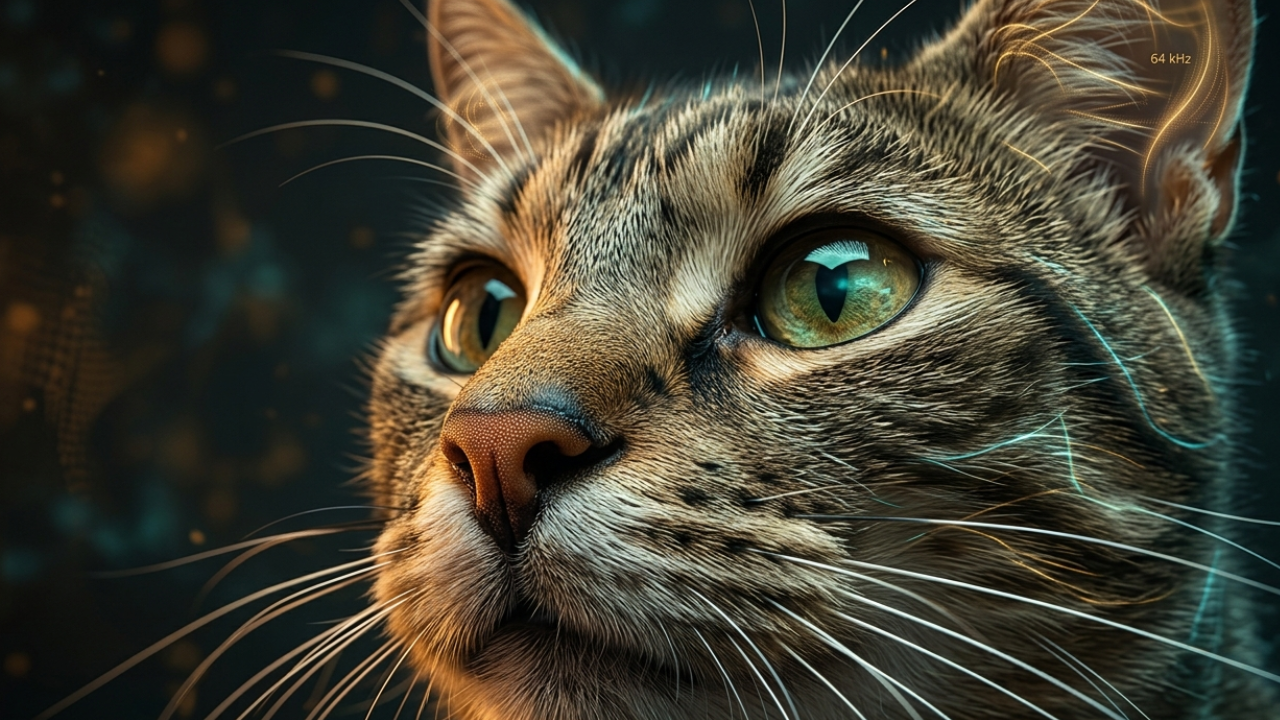
Have you ever looked at your cat and wondered if they have a secret superpower? As it turns out, they do. Beyond their mysterious stares and graceful movements lies a biological masterpiece refined by millions of years of evolution.
In this guide, we dive deep into the most fascinating cat facts that explain the “why” behind their strange behaviors.
look: Toxic foods for cats
1. The “Fingerprint” on Their Nose
Just like human fingerprints, a cat’s nose leather has a unique pattern of ridges and bumps. No two cats in the world share the same nose print. This “feline ID card” is so distinct that it could theoretically be used for identification, making every kitty truly one of a kind.
2. A Radar System with 32 Muscles
While humans have only 6 muscles in each ear, cats possess a staggering 32 muscles. This allows them to rotate their ears 180 degrees independently. They can pinpoint the exact location of a rustle in the grass from yards away without moving their head—a perfect tool for a silent predator.
3. Why Cats Can’t Taste Cupcakes
Biologically, cats are “obligate carnivores,” and nature has reflected this in their taste buds. Cats are the only mammals that lack the DNA to taste sweetness. They don’t have the sugar receptors (T1R2 and T1R3) that we do. To them, a piece of cake is just a bland texture.
4. The Biological Desalination Plant
One of the most extreme survival traits of cats is their ability to drink seawater. Their kidneys are so efficient that they can filter out the salt and utilize the water for hydration. This is a rare trait in land mammals and highlights their desert-dwelling ancestry.
5. Near-Sighted Hunters
Cats have incredible long-distance vision, but they suffer from functional blindness for objects closer than 10 inches (25 cm). This is why your cat might struggle to find a treat placed right under its nose. To compensate, they use their whiskers to “feel” what is directly in front of them.
6. Massive Eyes for Maximum Light
Cats have the largest eyes relative to their head size of any mammal. This isn’t just for cuteness; these large globes are designed to capture every stray photon. Combined with a reflective layer called the tapetum lucidum, cats can see clearly in only one-sixth of the light humans require.
7. Whiskers: More Than Just Facial Hair
A cat typically has 24 whiskers (12 on each side). These are not just hairs; they are highly sensitive tactile organs called vibrissae. They are deeply embedded in the nervous system to detect changes in air currents, helping them navigate in total darkness.
8. Can Cats Predict the Weather?
There is scientific weight to the old myth. A cat’s whiskers and inner ears are sensitive to barometric pressure changes. Before a storm, the drop in pressure can affect their equilibrium or make their whiskers feel heavy, leading to increased grooming (washing their face) to “reset” their sensors.
9. The “Liquid” Skeleton
Cats have about 230 bones—roughly 24 more than humans. However, their secret to being “liquid” is the lack of a functional collarbone (clavicle). Their shoulder blades are attached to the rest of the body by muscles, not bone, allowing them to squeeze through any gap as wide as their head.
10. Hearing: Outperforming the Best Guard Dogs
You might think dogs have the best ears, but cats are the champions. Cats can hear frequencies up to 64 kHz, while dogs top out at 45 kHz and humans at 20 kHz. This allows them to hear the ultrasonic squeaks of mice that are completely silent to us.
11. A Vocabulary of 100 Sounds
While dogs are limited to about 10 distinct vocalizations, cats have a repertoire of over 100 sounds. Interestingly, researchers believe that the “Meow” is a sound cats developed almost exclusively to communicate with humans, as adult cats rarely meow at each other.
12. A Wider View of the World
A human’s peripheral vision covers about 180 degrees. Cats, however, boast a 200-degree visual field. While their side vision isn’t as sharp as their central vision, it is expertly tuned to detect even the slightest movement, making it nearly impossible to sneak up on them.
13. The Five-Times-Height Leap
A healthy adult cat can jump roughly five to six times its own height in a single bound. This explosive power comes from the incredibly strong muscles in their hind legs and a flexible spine that acts like a coiled spring.